

Full-Spectrum Thinking: How to Escape Boxes in a Post-Categorical Future
Author: Bob Johansen


Citation: Citation: Johansen, B. (2020). Full-Spectrum Thinking: How to Escape Boxes in a Post-Categorical Future. Berrett-Koehler Publishers, Inc.
Why this book?
Full-Spectrum Thinking calls for a new mindset to lead oneself and others through the turbulent future. It is the third book in his leadership trilogy, which includes The New Leadership Literacies: Thriving in a Future of Extreme Disruption and Distributed Everything (2017) and Leaders Make the Future: Ten New Leadership Skills for an Uncertain World (2012).
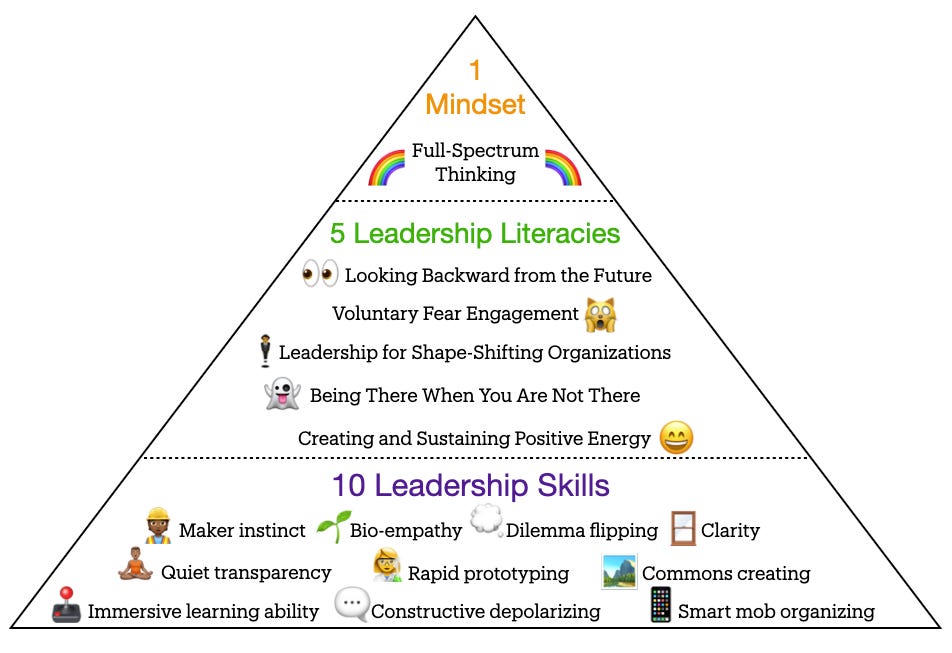
Johansen is a Distinguished Fellow at the Institute for the Future (IFTF). He has successfully used foresight methods throughout his career to forecast plausible, internally consistent stories of the future designed to provoke individuals and organizations to insight and action.
He warns we are headed toward an intense scramble—“an asymmetrical patchwork of urgency, panic, imbalance, and hope.” The key drivers are:
Rich-poor gap
Cyberterrorism and cybercrime
Global climate disruption (see IFTF 1978 Forecast)
These challenges must be solved outside the categories (i.e., thinking) of the past. Only a full-spectrum mindset will help us navigate through them.
Categorical thinking moves us away from understanding the bigger picture. It lacks context. Categories lead us toward certainty but away from clarity.
Key Ideas
We live in a time characterized by growing mistrust and confusion exacerbated by old ways of thinking and doing. Ambiguity and fear drive a need for certainty.
However, certainty is false certainty magnified by labeling, categorizing, oversimplifying, and blaming. Much today is unknowable, unpredictable, and more complex than certainty asserts.
The new leadership mindset is this: Communicate clarity in direction and practice maximum flexibility in getting there.
We can use futures thinking tools and emerging technologies to find clarity and open new pathways of action. These include:
Pattern recognition
Signals-gathering
Dilemma-flipping
Clarity filters
Forecasting by looking back 50 years to look ahead one year
and many more...
Why this matters
Trust & Mistrust
Paradoxically, in a world of declining trust, emerging technologies are both driving and addressing mistrust.
Living in a world of infinite data means that we must “trust but verify” continuously.
Blockchain is distributed computing that has the potential to provide high-trust interaction in low-trust environments. It provides transparency into the provenance (origin) of a digital object or record and publicly tracks changes overtime.
Blockchain is not just coins. In 2017, IFTF’s Blockchain Futures Forecast identified three waves of change from currencies to computing to commons. (These are the same stages in Chris Dixon’s new book, Read, Write, Own; my summary here.)
The sources of trust will become more distributed and more embodied in computer networks. The greatest power will be at the edges, not the center.
Clarity filtering is a key idea in the book and is an ancient practice: Think of village elders who served as voices of authority to help community members make sense of the world around them.
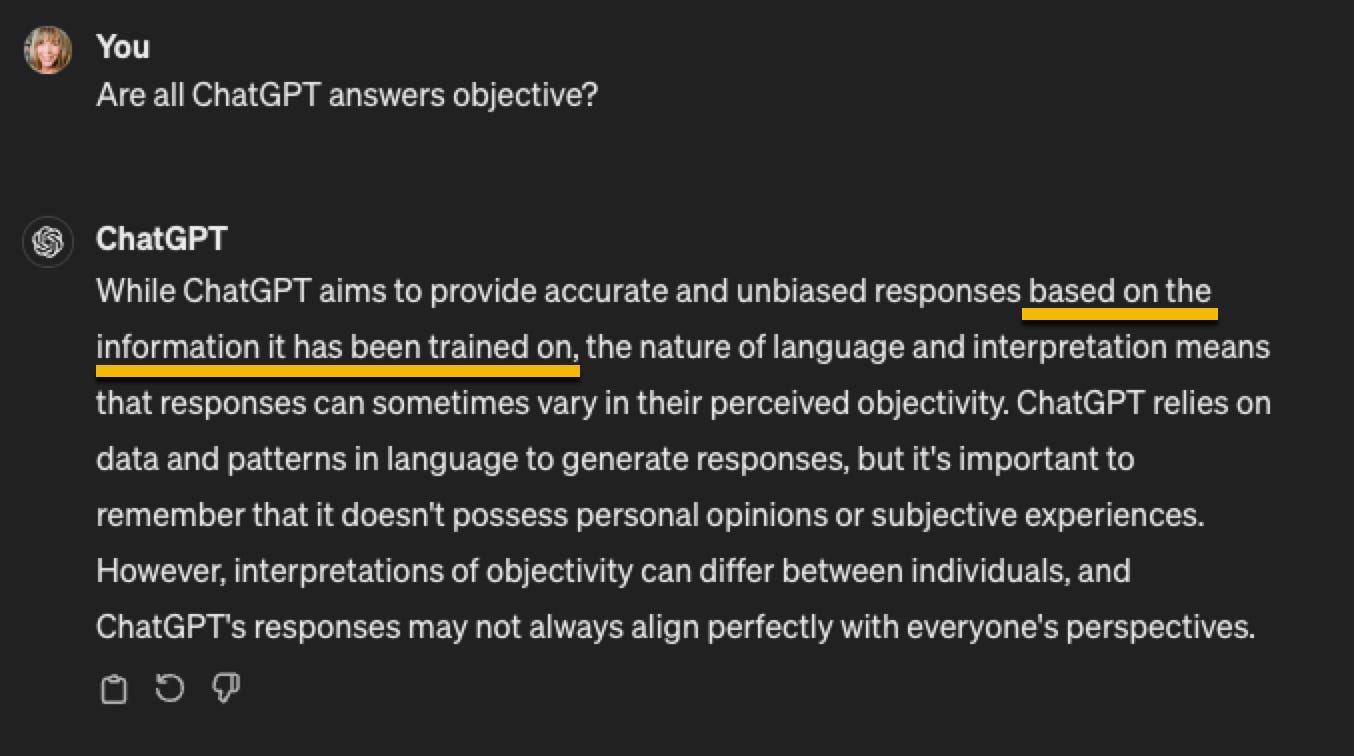
Emerging technologies, in part, can serve as clarity filters IF they are designed and used in such a way that they avoid the illusion of objectivity. For example, some perceive answers generated by ChatGPT to be authoritative and objective (although the ChatGPT response below qualifies its own objectivity).
Johansen cites a new clarity filter example: Big data visualization can allow us “step into” information worlds through immersive technologies to experience it with our bodies as well as our minds.
Computing in the future will be an immersive and ambient learning environment for humans.
Hierarchy & Distributed Autonomous Organizations (DAOs)
Given challenges of trust in society, and a shift in power from the center to the edges, we can expect more disruptions to occur in previously stable, hierarchical institutions — especially those whose leaders fail to embrace full-spectrum thinking.
Shape-shifting organizations will become common in which hierarchies come and go, and what was once centralized authority becomes decentralized. Job roles become more fluid posing challenges to rigid HR policies.
A Distributed Autonomous Organization is “managed in whole or in part by decentralized computer program, with voting and finances handled through a blockchain. In general terms, DAOs are member-owned communities without centralized leadership.” [1] Although, in social impact and crypto-altruism DAOs, people have some governance and coordination roles.
See KlimaDAO: a crypto answer to carbon markets - a social impact organization
Feel trapped in your current job? In the future, expect animated org charts in which people will play multiple roles in their organizations, and leaders will morph into followers as the projects change, then morph back into leaders again.

I’ve learned through long experience in forecasting that most really big change takes 30 to 50 years to be an overnight success. Almost nothing that happens is truly new. Almost everything that happened was tried and failed years before—especially in the technology space. The question to ask is not, What’s new? because if it is truly new, it is almost certainly not going to happen over the next decade. The question to ask is, What’s ready to take off?

Conclusion
There are so many thought-provoking ideas not described here due to length limitations. These include visions of the future of learning, roles for universities, and opportunities for multigenerational, diverse teams to gamefully address wicked problems, and more.
We need a new mindset. One only need read the daily news to see consistent patterns of volatility and disruption in which leaders, using old playbooks, are pouring gasoline on the fire to put it out. Full-Spectrum Thinking offers thoughtful strategies for action with real-world examples that inspire. I highly recommend all of Johansen’s leadership books.
Rating (out of 4): 🌟 🌟 🌟 🌟